Today, a patient looking for a specialist or a diagnostic test usually starts on Google. That makes your website, social media pages and Google Business Profile the front door of your healthcare organisation.
On October 6, 2026, the National Medical Commission (NMC) set clear rules for how that front door can be used. Its Ethics and Medical Registration Board issued the Guidelines on Ethical Advertising and Public Communication. Reports say they took effect immediately.
This guide explains what the rules say, what they mean for healthcare SEO and social media, and how to review your digital content. It is written for hospital owners, clinic managers, doctors, marketing teams and the agencies that support them. It is an educational overview, not legal advice.
What Are the NMC Advertising Guidelines 2026?
The NMC is India’s regulator for medical education and medical practice. Its Ethics and Medical Registration Board issued these guidelines to bring advertising and digital communication under ethical standards. The stated aim is to make communication about medical services truthful, transparent and responsible.
The guidelines cover advertising across traditional and digital platforms. Reports list television, radio, websites, social media, messaging apps, podcasts, influencer marketing, sponsored posts and AI-generated promotions.
The guidelines do not stop doctors or hospitals from talking about health online. They aim to stop health communication from becoming promotional or misleading.
In short, the rules focus on two lines: education versus promotion, and facts versus exaggeration.
Who Is Covered?
The guidelines address two groups:
- Registered medical practitioners (RMPs): individual doctors.
- Hospitals and medical institutions: clinics, diagnostic centres, hospitals and similar bodies.
The rules also reach the people who speak for these groups, including influencers, sponsored-content creators and third-party agencies. Hiring an outside company does not remove responsibility for the content it publishes for you.
The two groups do not face identical rules. Some provisions apply to individual practitioners and others to institutions. Read the official document before deciding which rules apply to you
What Counts as Advertising?
The definition is broad. A website page, a blog post, a WhatsApp broadcast, a paid Instagram reel and a Google Business Profile post can all count if they promote services. Reports say the rules cover websites, blogs, WhatsApp, Telegram, Facebook and other messaging platforms, podcasts and influencer marketing.
Ask one question about any piece of content: Is this giving the public useful, factual information, or is it trying to attract patients to a specific service?
- Educational: “What are the early signs of high blood pressure, and when should you see a doctor?”
- Promotional: “Visit our clinic for the best blood pressure treatment in the city.”
Both mention blood pressure. Only the second is advertising.
Patient Testimonials and Success Stories
This is the biggest change for doctors. Reports say a registered medical practitioner shall not request or share patient testimonials, recommendations, endorsements or reviews for professional promotion on social media.
Three points matter:
- Consent does not solve the problem. A patient agreeing to a testimonial does not make a promotional testimonial acceptable.
- Success stories count too. A post that tells a patient’s recovery story to attract new patients falls in the same risk zone.
- Soliciting is a risk. Asking patients to write reviews or share stories for marketing is treated differently from a patient voluntarily leaving feedback. Check the exact boundary with a legal adviser.
What to do now:
- Remove patient stories and testimonials from promotional pages and social posts.
- Stop asking patients for reviews to use in marketing.
- Train front-desk staff not to collect testimonials for the marketing team.
Before-and-After Images and Clinical Results
Clinical images are sensitive. Reports say the guidelines bar doctors from using their photographs for self-advertisement, solicitation or promotional publicity. Reports also restrict live broadcast or commercial sharing of surgical or clinical procedures that do not follow the guidelines.
For your website, this means:
- Do not use surgical photos, scan reports or before-and-after images to promote a treatment.
- Do not place a doctor’s photo in a promotional setting without checking the rules.
- If clinical content is used for education, keep it factual, anonymised and non-promotional, and get professional review before publishing.
Misleading Claims and Guaranteed Outcomes
Exaggerated language is one of the clearest risks. Reports say the guidelines restrict unverified claims such as “best” or “100 percent success.”
Some online summaries also list phrases such as “Guaranteed Cure,” “Miracle Treatment” and “Pain-Free.” I could not confirm these against the official text, but treat them as high-risk wording until you check.
The principle is simple: a claim must be verifiable.
- “We have treated over 500 patients with this procedure at our centre” is factual, if your records support it.
- “We are the best hospital for knee surgery” is an opinion that cannot be proven.
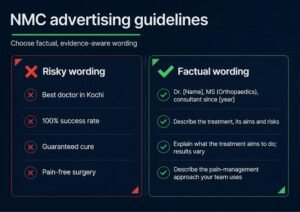
Replace risky wording with factual language:
| Risky wording | Safer, factual alternative |
|---|---|
| Best doctor in Kochi | Dr. [Name], MS (Orthopaedics), consultant at [Hospital] since [year] |
| 100% success rate | Describe the treatment, its aims and risks, and publish verified methodology if you have it |
| Guaranteed cure | Explain what the treatment aims to do and that results vary |
| Pain-free surgery | Describe the pain-management approach your team uses, without promising outcomes |
Changing one headline does not make a campaign compliant. The whole page, image, caption and call to action must follow the rules.
AI-Generated Healthcare Advertising
AI is now part of most marketing teams, and the guidelines address it directly. Reports say the NMC has specifically included artificial intelligence within the definition of advertising.
Reports say the guidelines prohibit doctors and hospitals from using AI-generated content for advertising their services, soliciting patients, or disseminating unverifiable information about diagnoses, treatments and outcomes. They also bar fabricated patient experiences and endorsements.
High-risk uses include:
- AI-generated patient testimonials or stories.
- AI avatars or synthetic “doctors” in promotional content.
- AI-generated before-and-after images or simulated outcomes.
- AI-written claims about treatment results that cannot be verified.
Internal uses, such as drafting an outline or summarising your own policy documents, are a different matter. The rules focus on promotional output. Even so, every AI-assisted draft needs human review by someone who checks the facts.
Reviews, Ratings and Search Ranking Manipulation
Fake engagement damages patient trust. Buying reviews, buying followers, or inflating ratings is risky. Reports say the guidelines also restrict paid rankings on healthcare platforms.
Ordinary SEO is not the problem. Improving page titles, fixing broken links, speeding up pages and writing clear content about your services are normal activities. The concern is manipulation that creates a false impression of expertise or popularity.
Do not:
- Buy reviews or ratings.
- Offer incentives in exchange for positive reviews.
- Pay for placements that present themselves as independent rankings.
Social Media Rules for Doctors and Hospitals
The guidelines do not ban social media. Reports note the NMC has not prohibited doctors from using social media or other public platforms altogether.
Doctors can publish factual, evidence-based health awareness material without promotional intent. Hospitals can share objective administrative information about facilities and infrastructure.
For electronic-media posts, reports say doctors must disclose their name, qualifications, registration status and State Medical Register or National Medical Register number.
Checklist for every social post:
- Is it educational or promotional?
- Are the required practitioner details included?
- Does it avoid patient stories and testimonials?
- Does it avoid unverifiable claims?
- Has any paid promotion been reviewed before it goes live?
Influencers, Sponsored Posts and Agencies
Many clinics work with influencers or outside agencies, and the guidelines cover these arrangements. Hiring an agency does not remove responsibility. If a hospital or doctor commissions, approves or allows content that breaks the rules, they can still be held accountable.
Review every contract. Check:
- Who approves content before it goes live?
- Are influencer posts labelled and reviewed?
- Does any arrangement pay for patient referrals or leads?
Paying for legitimate services, such as web development, technical SEO or content editing, is different from paying for patient solicitation. Ask a lawyer to review any arrangement you are unsure about.
Discounts, Free Procedures and Referral Benefits
Patients like offers, but the guidelines restrict inducements. Reports say doctors and hospitals cannot offer limited-period discounts, coupons, gift packages or referral benefits that are likely to encourage unnecessary consultations.
Fear-based messaging is also risky. Campaigns that push people toward tests or procedures they do not need can damage trust and may breach the rules.
Transparent, factual fee information is a different matter. The concern is with inducements that push people toward unnecessary care.
What Hospitals Can Communicate
Hospitals still have plenty of room to communicate. Reports say hospitals can share objective details about their services, including:
- Name, address and contact details.
- Departments and specialties.
- Facilities and equipment.
- Visiting hours and appointment information.
- Emergency service information.
- Verifiable accreditations.
Reports also note that a hospital website’s doctor directory, listing names, qualifications, specialties, registration details and availability, can serve a patient-information function. The key word is factual. A directory is information. A paragraph saying “our surgeon is the finest in the state” is promotion.
Doctor Profiles and Professional Information
Doctor profiles must be accurate and consistent everywhere. Check that these match across your website, social media, Google Business Profile and directory listings:
- Full name and designation.
- Recognised qualifications.
- Specialty and areas of practice.
- Registration status and registration number.
- Clinic address and consultation timings.
Inconsistent information damages both trust and search visibility.
What Do the NMC Guidelines Mean for Healthcare SEO?
SEO is not banned. Healthcare websites still need to be found. What changes is the content and the methods.
Usually fine, when content is accurate:
- Technical SEO: fixing crawl errors, improving mobile speed and repairing broken pages.
- Page titles and meta descriptions that describe the page honestly.
- Structured data that accurately describes your organisation, location and services.
- Accessible design, readable text and alt text for images.
- Well-organised internal links.
- Accurate Google Business Profile information.
Needs careful review:
- Keyword pages with promotional or superiority claims, such as “best hospital in [city].”
- Blog posts that read as advertisements.
- Patient stories used to chase search terms.
- Anything that fakes authority or reviews.
Rankings are not proof of trust. A page that ranks because it is accurate and useful is a good result. A page that ranks because it breaks the rules is a risk.
Ethical AEO and GEO for Healthcare Websites
Answer Engine Optimisation (AEO) means structuring content so search engines can give direct, accurate answers. Generative Engine Optimisation (GEO) means making content clear and reliable enough for AI tools to use when they answer questions.
For healthcare websites, that means:
- Clear answers to common administrative questions, such as “What documents do I need for a first visit?”
- Accurate department descriptions.
- Verifiable credentials for doctors.
- Logical page structure with descriptive headings.
- Educational FAQs that cite reliable sources.
- Regular content updates.
These methods do not guarantee that an AI tool will mention your hospital. No one can promise that. Do not use AI search optimisation to make promotional material look like neutral medical education, because that works against the purpose of the guidelines.
Healthcare Content Marketing After the Guidelines
Content marketing still works for healthcare when it is genuinely useful. Good topics include:
- General health education.
- Public-health awareness.
- Patient preparation instructions for tests and procedures.
- Visiting, appointment and billing information.
- Plain-language explanations of diagnostic processes.
- Educational FAQs.
Every medical article needs review by a qualified professional. Avoid treatment recommendations that go beyond general education. Patients should understand that a blog post is not a substitute for a consultation.
Google Business Profile and Local SEO
Google Business Profile is one of the most useful tools for local healthcare visibility. Keep it accurate:
- Name, address, phone number and opening hours.
- Services and departments.
- Photos of the real facility, not edited or misleading images.
- Professional, factual responses to reviews.
Do not ask patients to leave reviews in exchange for anything. Do not create fake reviews. Apply the same standards to posts on your profile as to your website.
How to Audit a Healthcare Website Under the NMC Guidelines
This is a practical content and digital audit. It is not a legal compliance certificate.
- List every important page, including blogs, landing pages and doctor profiles.
- Review promotional language for superiority claims and guarantees.
- Identify all testimonials, patient stories and patient images.
- Check doctor credentials and registration details against official records.
- Review social media posts and paid campaigns.
- Review contracts with influencers and agencies.
- Check AI-generated text and images for unverifiable claims.
- Review how you handle reviews and ratings.
- Check technical SEO and accessibility.
- Set up an approval process before anything is published.
- Record issues found and fixes made.
- Get legal or regulatory advice on anything uncertain.
| Audit area | What to check | Potential concern | Suggested next action |
|---|---|---|---|
| Website pages | Promotional wording, superiority claims | Unverifiable claims | Rewrite with factual language |
| Testimonials | Patient quotes, success stories | Promotional use | Remove or get legal review |
| Clinical images | Before-and-after, surgical photos | Promotional use | Remove from promotional pages |
| Doctor profiles | Qualifications, registration number | Missing or inconsistent details | Verify and update |
| Social media | Posts by doctors and hospitals | Missing disclosures, promotional tone | Add required details, review tone |
| Paid ads | Claims, offers, discounts | Inducements, unverifiable claims | Pause and review |
| Influencers and agencies | Contracts, approvals | Responsibility for third-party content | Add a review step to contracts |
| AI-generated content | Synthetic people, outcomes | Fabricated endorsements | Remove and replace with verified content |
| Reviews | Solicited reviews, paid ratings | Manipulation | Stop the practice, respond professionally |
| Technical SEO | Speed, mobile, structured data | Accuracy of structured data | Fix and validate |
| Approval process | Who signs off content | No accountability | Document a sign-off workflow |
Penalties
Reports say violations could lead to serious consequences, including suspension or removal from the medical register. Violations are assessed case by case, and the relevant State Medical Council has a role. Do not assume a particular penalty follows from a particular issue. Read the official document for the full structure.
Compliance Checklist
- Website pages free of superiority claims and guarantees
- No patient testimonials or success stories used for promotion
- No promotional use of clinical or surgical images
- Doctor profiles match official registration records
- Social posts include required practitioner details where applicable
- AI-generated content reviewed, with no fabricated people or outcomes
- Influencer and agency contracts include content approval
- No paid reviews, incentivised reviews or fake engagement
- No discounts or inducements that encourage unnecessary care
- Institutional information accurate and up to date
- Consent and privacy procedures in place
- Editorial approval process documented
When in doubt, seek professional advice before publishing
How Hopeinstance Technologies Can Help
Hopeinstance Technologies is a digital marketing and web services company. We can support healthcare organisations with:
- Technical SEO audits.
- Website structure and metadata review.
- Content reviews for accuracy and tone.
- Accessibility and usability improvements.
- Checks on consistency of institutional information.
- Educational content workflow design.
- AEO and GEO strategy.
- Website enquiry-path reviews.
- Documentation of digital publishing processes.
We do not offer to bypass regulatory rules, and we do not promise rankings, patient numbers or AI citations. Every engagement is assessed against the applicable professional and regulatory requirements, and we work with your legal advisers where needed.
Need help reviewing your healthcare website?
Hopeinstance Technologies helps organisations assess website structure, technical SEO, content quality, accessibility and AI-search readiness. Talk to our team at www.hopeinstance.com or call +91 95444 84898 to discuss a website and digital content review tailored to your organisation.
Frequently Asked Questions
What are the NMC Advertising Guidelines 2026?
Guidelines issued by the NMC’s Ethics and Medical Registration Board on October 6, 2026, covering ethical advertising and public communication by hospitals and registered medical practitioners.
When did they take effect?
Reports say they came into immediate effect after issue.
Who is covered?
Registered medical practitioners and hospitals or medical institutions, along with the agencies and influencers who promote them.
Can doctors use social media for health education?
Yes. Reports say factual, non-promotional health education is permitted.
Are patient testimonials allowed?
Reports say doctors may not request or share patient testimonials for professional promotion on social media. Consent alone does not change this.
Can hospitals publish factual information online?
Yes. Departments, facilities, contact details and verifiable doctor directories are generally treated differently from promotion.
Are before-and-after photographs allowed?
Reports say promotional use of clinical and surgical images is restricted. Check the official text before using any clinical image.
Can AI be used in healthcare marketing? Reports say AI-generated promotional content, fabricated testimonials and unverifiable outcome claims are restricted. Human-reviewed, accurate content is the safe approach.
Is SEO prohibited?
No. Technical SEO and accurate content are normal. Manipulation and promotional claims are the concern.
Are paid reviews and rankings prohibited?
Reports say paid rankings on healthcare platforms are barred, and buying or incentivising reviews is risky.
What penalties apply?
Reports mention possible suspension or removal from the medical register. Check the official document for the full structure.
How can we review our digital content?
Use the audit workflow and checklist above, and get legal or regulatory advice for anything uncertain.
Conclusion
The NMC guidelines ask healthcare organisations to put accuracy, patient privacy and ethical communication first. That protects patients and the profession. Review your websites, social media, Google Business Profile and agency contracts now. Remove what is promotional or unverifiable, and make your factual information easier to find.